

Turf houses

Have you ever wonder how an isolated community, living in harsh conditions, without an easy access to metal goods would build their homes?
Turf houses are an integral part of the Nordic culture of Iceland. Although similar architectural tradition has been seen in other nordic regions such as Norway, Scotland, Ireland, Greenland, the Faroe Islands and the Great Plains of North America throughout time, Icelanders used this technique for a considerable amount of time - from the 9th to the 20th century! The historic records show that up until the 19th century, 50% of the Icelandic population was still living in turf houses, the last habitants left their traditional houses around 1966. Coming from the arrival of the Norse and the British settlers, during the top of the Viking Age, those houses needing a lot of maintenance were then replaced by more modern buildings.
Abundant, ecological and renewable, turf became the choice of predilection for the shelter constructions in Iceland. The choice of this material had more than one benefit and this is due to the climate condition of the country. The wooden layer (mostly timber), the turf grass and the stacks of earth was giving a natural isolation from the strong winds and difficult weather of the beautiful land. The foundation was mostly made of large flat stones and would always feature an impressive fire pit as the center of the building which was essential during the long cold winters of Iceland
During the 1000 years that turf houses were used, their style changed significantly. For example, during the 14th century, the long viking houses were changed into many small interconnected houses. In the 18th century, the burstabær style became more popular with wooden extremities (at the back and at the front) instead of having only the wooden door. This style has been adopted and are the ones that we are still able to see and visit nowadays.
With time, the population started to cluster in bigger cities like Reykjavik and let behind the traditional technique of stone masonry and earthen architecture and moved to wood buildings. Only after several earthquakes and fires flattening the city, Icelanders switched to a safer and stronger building material; concrete and steel.
You don't have to go far to see a turfhouse as Árbæjarsafn museum has one of the few remaining turf houses in Iceland, Árbær turf farm, the only remaining turf farm in Reykjavík, which was inhabited until 1948. The first written records of a farm at Árbær dates back to 1464 and have been reconstructed through the years. Turf houses need constant maintenance due to the nature of their building material; turf, rocks and timber.
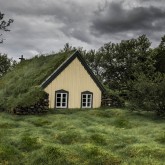
You can also take a road trip and visit some of these Icelandic treasures in several parts of the island and some within a short drive from Reykjavik. One of those is Núpstaðarkirkja, a cute little turf church located in south Iceland, only an hour drive from Reykjavík. The historical Keldur site is believed to be the oldest turf house sites that survived through time in Iceland. Located in South Iceland, shortly over an hour and a half driving from Reykjavik, it is believed to be in place since the middle age. A bit further in the South East of the island you will find Hofskirkja church. This fairy-tale looking church should be on the top of your list. Although it is pretty recent, constructed in 1884 and heavily restored in the 1950´s, it is the only turf building still being used for its initial purpose.